
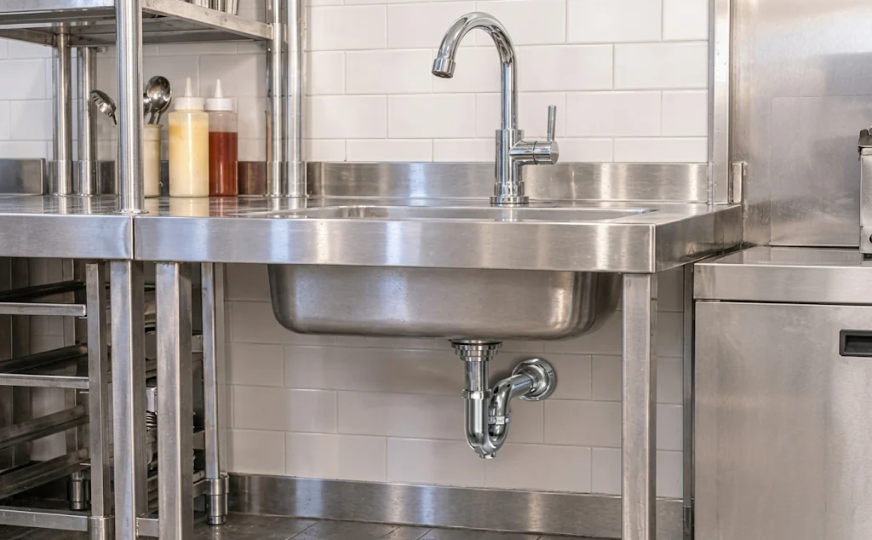
Picking a kitchen faucet is about more than looks. The style you choose decides how many holes your sink needs, how much space you need under the counter, and how easy the install will be. This guide compares pull-down, touchless and bridge faucets, shows you how to check that a faucet fits your sink, and gives separate buying tips for readers in the US and Canada.
Pull-Down, Touchless and Bridge Faucets at a Glance
| Style | How it works | Holes needed | Best for | Check before you buy |
|---|---|---|---|---|
| Pull-down | The spray head pulls down on a hose to rinse pots and the sink | Usually 1 (many models also fit 3-hole sinks with a deck plate) | Deep sinks and everyday cooking | Clearance above the sink, and room under the sink for the hose and weight |
| Touchless | A sensor starts and stops the water | Usually 1 | Cooking with messy hands | Power source (batteries or AC adapter) and room for the control box |
| Bridge | Two handles joined by a bridge, with a swing spout in the middle | Usually 2, often spaced 8 inches apart | Traditional and farmhouse kitchens | Hole spacing and deck thickness |
Pull-Down Kitchen Faucets
A pull-down faucet has a spray head that pulls down toward the sink on a flexible hose. It is a popular choice because one hand can rinse a pot, a cutting board or the corners of the sink.
- Reach: The hose lets you rinse the whole basin, not just the center.
- Height: Many pull-down models stand roughly 16 to 18 inches above the sink deck. Check the space under a window sill or wall cabinet before you order.
- Under the sink: The hose and its counterweight need free space below. Do not store items where the hose hangs.
- Holes: Most single-handle pull-down models need one hole, usually 1-3/8 to 1-1/2 inches in diameter.
Touchless Kitchen Faucets
A touchless faucet uses a sensor to turn the water on and off. It has four main parts: the spout, the sensor, a solenoid valve and a power source.
- Hands-free use: Handy when your hands are covered in dough or have touched raw meat.
- Power: Touchless faucets need power for the sensor and valve. This comes from batteries or an AC adapter. Battery models need no electrical work, because the battery pack mounts under the sink.
- Space: Plan room under the sink for the control box and battery pack, and keep it reachable so you can change the batteries.
- Upkeep: Replace the batteries when the faucet signals low power, and wipe the sensor window now and then. Some models also have a manual override.
Bridge Kitchen Faucets
A bridge faucet joins two handles with a horizontal bridge and has a swing spout in the center. It suits traditional, farmhouse and vintage-style kitchens.
- Holes and spacing: Most bridge faucets install in two holes with 8 inches between the centers. Some models add a third hole for a side spray.
- Fit: Because the spacing is fixed, a bridge faucet generally will not fit a single-hole sink. Measure before you buy.
- Deck thickness: Spec sheets for bridge faucets list limits from roughly 1-1/4 to 3 inches, so check yours against the model you like.
- Pull-down option: Some bridge models include a pull-down spout if you want the classic look with a hose.
How to Check Sink-Hole Compatibility
Check these six things before you place an order:
- Count the holes. Include any holes used by a soap dispenser or side spray. Many single-handle faucets can cover extra holes with a deck plate, but check the product listing.
- Measure the hole diameter. Most faucet spec sheets call for holes between 1-3/8 and 1-1/2 inches (about 35 to 38 mm).
- Measure the spacing. For a two-hole bridge faucet, measure from the center of one hole to the center of the other. Eight inches is common.
- Measure the deck thickness. Include the sink and countertop together. Spec sheets list a maximum deck thickness, and it varies by model.
- Check space behind the faucet. Several spec sheets recommend at least 2-1/2 inches of clearance between the faucet and the backsplash.
- Check height and reach. Make sure the spout reaches the middle of the basin and clears any window or cabinet above.
Always compare your measurements with the manufacturer’s spec sheet for the exact model, because sizes vary.
Installation Tips
- Turn off the hot and cold water supply valves before you start.
- Read the full manufacturer instructions and keep the spec sheet.
- Flush the supply lines before you attach the spray head, so debris does not clog it.
- For pull-down faucets, set the counterweight so the hose returns smoothly.
- For touchless faucets, mount the battery pack where you can reach it and test the sensor before you finish.
- Turn the water on and check every connection for leaks, including the drain connection under the sink.
While You’re Under the Sink, Check the P-Trap
A faucet swap is a good time to look at the drain trap under your sink. A P-trap holds a small amount of water that blocks sewer gas from rising back into the room, and it carries wastewater from the sink to the wall drain.
You do not need a new P-trap every time you change a faucet. Consider replacing it if you see leaks at the joints, corrosion, or a trap that is hard to clear when it clogs.
If you want an easy-to-clean option, the cast iron P-trap with cleanout plug and box flange from Plumbing Objects is made for 1-1/2 inch sink drains. Here is what the product page lists:
- Size: 1-1/2 inch, for standard 1-1/2 inch sink drains
- Cleanout plug: Unscrew it at the bottom of the trap to clear a blockage without taking the whole trap apart
- Box flange: Covers the wall opening for a tidy finish
- Material and finish: Cast iron with a chrome plated finish
- In the box: Coupling nuts and washers
- Dimensions: 11 inches long, 4.9 inches high, 3.0 inch flange diameter
- Use: Kitchen, laundry and bathroom sinks, residential and commercial
- Warranty: 4 years
Check the fit first. Measure your sink drain and wall outlet to confirm both are 1-1/2 inch, and check that the trap’s length and height suit your space. The flange covers a wall opening, so this trap is meant for a drain that enters through the wall. If you are not sure, contact our support team and we will help you check the size and fit.
Buying Tips for US Readers
- Look for the standards. Check the spec sheet for ASME A112.18.1/CSA B125.1, and for NSF/ANSI 61 and NSF/ANSI 372 (lead content).
- Know your local code. The US uses several model plumbing codes, and your state or city decides which one applies. Ask your local building department if you are unsure.
- California and Massachusetts: Spec sheets in these states often list California Energy Commission (CEC) compliance or Massachusetts approval. Look for them if you live there.
- Flow rate: In the US it is listed in gallons per minute (gpm). Many kitchen faucet spec sheets list 1.5 to 1.8 gpm.
- Accessibility: If you need an accessible kitchen, check for ADA and ICC A117.1 compliance.
Buying Tips for Canadian Readers
- Same core standard: ASME A112.18.1/CSA B125.1 has identical requirements across the US and Canada, so look for it on the spec sheet. Also look for NSF/ANSI/CAN 61 and NSF/ANSI/CAN 372 certification.
- Local rules: The National Plumbing Code of Canada is enforced by provinces and territories, so check your local requirements before you install.
- Use metric measurements. A typical faucet hole is about 35 to 38 mm. Flow is listed in litres per minute (1.8 gpm is about 6.8 L/min), and many manufacturers publish combined US/Canada spec sheets with both units.
- Check the seller. Before you order, confirm that the seller ships to Canada and that shipping costs, duties, warranty and returns apply to your address.
- Match the listing to your market. Choose a model whose documentation lists Canadian compliance, not only US compliance.
Frequently Asked Questions
What size hole does a kitchen faucet need?
Most kitchen faucet spec sheets call for a hole between 1-3/8 and 1-1/2 inches (35 to 38 mm). Check the exact model.
Do touchless faucets need electricity?
They need power for the sensor and valve. Many use a battery pack under the sink, so no electrical work is needed, while some can use an AC adapter.
Can I install a bridge faucet on a single-hole sink?
Generally no. Bridge faucets are made for two holes with fixed spacing, often 8 inches. Check the spec sheet.
Do I need to replace my P-trap when I replace my faucet?
No, but it is a good time to inspect it for leaks, corrosion and clogs.
Final Thoughts
Pull-down faucets suit everyday cooking, touchless faucets help when your hands are messy, and bridge faucets bring a classic look. Whichever you choose, measure your holes, spacing, deck thickness and clearance first, and compare them with the manufacturer’s spec sheet. If you are working under the sink anyway, check your drain trap too.